


In the congested landscape of casushi online casino platforms, a seamless and secure entry point is not just a convenience—it’s the foundation of the user experience and operational integrity. This guide is a comprehensive technical dissection and operational handbook focused on the casushi casino login process and the ecosystem it protects. We will move beyond basic instructions to explore the underlying architecture, security protocols, financial mathematics, and troubleshooting logic that define a modern iGaming portal. Understanding these systems is crucial for both optimizing your play and safeguarding your digital footprint within casushi casino online.
Before You Start: The Prerequisite Checklist
Failing to prepare is preparing for login failures and verification delays. Before you even navigate to the portal, ensure these technical and regulatory boxes are ticked.
- Jurisdiction Verification: Confirm that online gambling, and specifically Casushi, is legally accessible from your physical location. Attempting to access from a restricted territory will result in an immediate IP block.
- Document Readiness: Have clear, high-resolution scans or photos of a government-issued ID (passport, driver’s license), a recent utility bill or bank statement (less than 3 months old for proof of address), and the payment method used for deposit (front of card with middle digits obscured, or e-wallet account screenshot).
- Browser & Device Configuration: Use an updated browser (Chrome 90+, Firefox 88+, Safari 14+). Enable JavaScript and cookies. Disable overly aggressive pop-up blockers that may interfere with the login portal or game client.
- Network Security: Avoid public Wi-Fi for registration, first login, and financial transactions. Use a private, secure connection. A VPN is acceptable only if it does not route your traffic through a restricted country.
- Unique Credentials: Prepare a truly unique password (12+ characters, mix of cases, numbers, symbols). Do not recycle passwords from other sites. Have a valid, accessible email address ready for account confirmation.
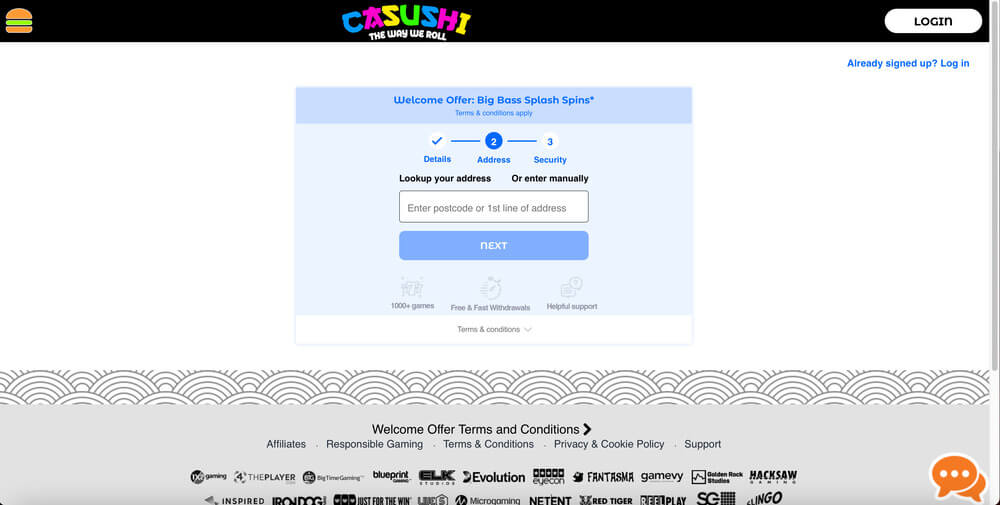
Account Genesis: The Registration & First Login Protocol
The registration process is the first security gate. It’s not merely about creating an account; it’s about establishing a verifiable digital identity.
- Portal Access: Navigate to the official Casushi website. Casushi casino login is your primary gateway. Be wary of phishing sites—always verify the URL uses HTTPS and the correct domain.
- Data Submission: Click “Sign Up” or “Register.” You will be required to enter precise personal data: Full legal name (must match ID), date of birth, current physical address, email, and phone number. Inaccuracy here guarantees failed verification later.
- Credential Creation: Choose your username and the strong password you prepared. This password is hashed and salted in the database; not even support can retrieve it, only reset it.
- Initial Verification (Email/SMS): Before first deposit, you must verify your email via a link and often your mobile number via a one-time PIN (OTP). This is a basic 2-factor authentication (2FA) layer.
- The First Login: Use your new credentials at the login panel. The system may perform a preliminary geolocation check. Successful entry triggers the creation of your user session token and wallet instance.
Mobile Access: App vs. Browser Client Analysis
Accessing casushi online casino on mobile presents two distinct architectural choices, each with pros and cons.
- Native Application (iOS/Android): Available via official app stores. Offers optimized performance, push notifications for bonuses, and potentially biometric login (Touch ID, Face ID). The app is a wrapped browser client but with deeper OS integration for stability. Installation requires trusting the developer certificate.
- Mobile Browser: Access via Safari, Chrome, etc., on your device. No installation needed. Always delivers the most updated version of the site. However, it is subject to browser cookie policies and may be less stable with complex games. Ensure ‘Desktop Site’ mode is off for proper responsive design.
| Category | Specification | Technical Implication |
|---|---|---|
| License & Regulation | Malta Gaming Authority (MGA) | Operations bound by strict EU player protection, fairness, and anti-money laundering (AML) directives. |
| Account Security | SSL Encryption (256-bit), optional 2FA | All data transmission is encrypted. 2FA adds a time-based token layer on login/withdrawals. |
| Session Management | Timeout: 10-20 mins inactivity | Automatic logout to prevent session hijacking on unattended devices. |
| Game Fairness | RNG Certified by iTech Labs, eCOGRA | Random Number Generator audits ensure unpredictable, fair game outcomes. Publishes RTP reports. |
| Login Methods | Username/Password, Biometric (App), Social Sign-in (?) | Multiple authentication factors. Social sign-in (e.g., via Google) delegates security to that provider. |
| Support System | Live Chat, Email, FAQ Knowledge Base | Chat uses encrypted connection. Response time is a key performance indicator (KPI) for the operator. |
Bonus Mathematics: Calculating the True Cost of “Free” Money
Welcome bonuses are contractual obligations, not gifts. Understanding the math is critical to evaluating their value. Let’s model a common offer: “€1000 Bonus + 200 Free Spins on a 100% first deposit match with a 40x wagering requirement (WR).”
Variables: Deposit (D) = €500. Bonus (B) = €500. Wagering Requirement (WR) = 40x(B). Game Contribution (GC) = Slots (100%), Table Games (10%).
Scenario 1: Playing Slots Only.
Total Wager Required = B x WR = €500 x 40 = €20,000.
If playing a slot with 96% RTP, the expected loss from wagering this bonus is (1 – 0.96) x €20,000 = €800. Since the bonus was €500, the expected net position is -€300. This demonstrates the “cost” of the bonus.
Scenario 2: Mixing Game Types.
If you wager €10,000 on slots (100% contribution) and €10,000 on roulette (10% contribution), your effective wagering is: €10,000 + (€10,000 x 0.10) = €11,000. You have not met the €20,000 effective requirement. This is a common pitfall. The system tracks contributions separately per game type.
Key Takeaway: The optimal strategy is to clear bonuses exclusively on high-contribution games (slots, often 100%) to minimize the wagering time and variance impact.
Banking Architecture: Deposit & Withdrawal Node Analysis
The financial pipeline is a critical node where logins, security, and processing times intersect.
- Deposit Node: Instant processing. Requires login and often CVV confirmation. May trigger a soft KYC check. Minimum deposits (€10-€20) apply. Methods include Credit/Debit Cards (Visa/Mastercard), E-Wallets (Skrill, Neteller), Prepaid Vouchers (Paysafecard), and Bank Transfer.
- Withdrawal Node: The security bottleneck. Always requires full account verification (KYC) before first payout. Process: 1) Login, 2) Request payout to a verified method, 3) Internal audit (24-48 hours), 4) Processing by provider (instant for e-wallets, 1-5 days for cards/bank). Pending Period: A 24-48 hour window where you can cancel the withdrawal, a regulatory cooling-off feature.
- Limits: Weekly/Monthly withdrawal limits exist (e.g., €10,000/week). Check the cashier section. Large wins may be paid in installments.
Security Deep Dive: Encryption, Cookies, and Session Hijacking
The casushi casino login system employs a multi-layered security model.
- TLS/SSL Encryption: The padlock icon in your browser signifies a TLS 1.2+ connection. This encrypts all data between your device and Casushi’s servers, making login credentials unreadable in transit.
- Cookie Usage: Upon login, the server issues a session cookie to your browser. This cookie, not your password, authenticates you for subsequent page loads. The “Remember Me” function extends the cookie’s lifespan but is inadvisable on shared devices.
- Hashing & Salting: Your password is never stored. It is run through a one-way hash function (like bcrypt) with a unique “salt.” The resulting hash is stored. On login, your input is hashed and compared to the stored hash.
- Defense Against Hijacking: Session tokens are invalidated on logout, after timeout, or if a login is detected from a new device/IP, forcing re-authentication.
Troubleshooting Engine: Diagnosing Common Login Failures
When the login node fails, systematic diagnosis is required. Here are common error states and their root causes.
- Error: “Invalid Username or Password”
- Diagnosis: Input error, caps lock on, or a genuinely incorrect credential.
- Action: Use the “Forgot Password” flow. This sends a password reset link to your registered email. If the email doesn’t arrive, check spam and that you’re using the correct email address.
- Error: “Account Disabled” or “Please Contact Support”
- Diagnosis: This is a serious system-level block. Causes include: Failed KYC verification, suspected duplicate account, detected bonus abuse, or a self-exclusion request.
- Action: You must contact support directly via email or live chat. Have your ID ready. The resolution depends on the internal flag on your account.
- Error: Page Not Loading / Blank Login Form
- Diagnosis: Local browser cache/cookie corruption, aggressive ad-blocker/firewall, or ISP-level blocking.
- Action: Clear browser cache and cookies for the site. Disable browser extensions one by one. Try a different browser or device. Use mobile data instead of Wi-Fi to rule out network filtering.
- Error: Unable to Verify Location
- Diagnosis: Your IP address is flagged as being from a restricted country, either because you are there, or your VPN/Proxy is leaking.
- Action: Disable VPN/Proxy. If you are legitimately in a permitted country, your ISP may be routing traffic through a problematic node. Restarting your router can sometimes assign a new IP.
Extended FAQ: Technical & Operational Queries
- Q: I’ve lost my username. How can I recover it?
A: Usernames are often not recoverable via an automated system for security reasons. Use the “Forgot Password” function with your registered email; the reminder email may contain your username. Otherwise, contact support with your full name, date of birth, and email to request it. - Q: Why does Casushi require so much documentation for verification?
A: This is a non-negotiable legal requirement under its MGA license and AML laws. It prevents identity theft, money laundering, underage gambling, and fraudulent chargebacks. The process is typically once per account lifetime. - Q: Can I have multiple accounts at Casushi casino online?
A: No. One account per person, household, IP address, or payment method is strictly enforced. Creating multiple accounts to claim bonuses (“bonus hunting”) will lead to all accounts being permanently closed and all winnings voided. - Q: Is it safe to save my password in the browser?
A: From a platform security perspective, yes, Casushi’s systems are secure. However, from a local device security perspective, it’s a risk if your device is shared or compromised. Using a dedicated, reputable password manager is a more secure alternative. - Q: What happens to my balance if my session times out while I’m in a game?
A: Game state is managed by the game server, not your local session. If you are disconnected or logged out mid-spin or mid-hand, the game round will complete on the server. Any winnings will be credited to your account balance, which you can access after logging back in. - Q: How does the “Remember Me” function work technically, and is it safe?
A> It places a persistent cookie on your device with a long-lived token. This token allows automatic re-login. It is reasonably safe on a private device but should never be used on public or shared computers, as it bypasses the password requirement. - Q: I made a deposit but the money was taken and my balance isn’t updated. What’s wrong?
A: This is a transaction processing failure at the payment gateway node. First, check your bank/e-wallet statement to confirm the debit. Then, wait 10-15 minutes. If balance isn’t updated, contact support immediately with the transaction ID. Do not attempt to deposit again, as it may cause a duplicate charge. - Q: Can I change my registered email address or username?
A: Changing your email is usually possible but requires contacting support and verifying your identity again, as it’s a core account identifier. Changing a username is often not permitted due to database architecture and fraud prevention systems. - Q: What is the difference between a “withdrawal pending” period and “processing” time?
A> “Pending” is an internal security and cooling-off period (often 24-48 hrs) where Casushi finalizes audits and allows you to cancel. “Processing” begins after pending ends and is the time it takes for the chosen payment provider (Skrill, Visa, etc.) to move the funds to you. - Q: If I suspect my account has been compromised, what are the immediate steps?
A: 1) Immediately change your password via the “Forgot Password” flow. 2) Contact Casushi support to report the breach and have them freeze the account. 3) Request a review of recent transactions. 4) Enable 2FA if available after regaining access.
Conclusion: Mastering the Gateway
This technical manual has deconstructed the casushi casino login from a simple credential entry into a complex interaction with security, financial, and regulatory systems. Success within casushi online casino is predicated on understanding these systems. By preparing your documentation, comprehending the mathematics of bonuses, respecting the security protocols, and methodically troubleshooting issues, you transform from a casual user into an informed participant. The login is your key—handle it with the same care you would the key to a high-security vault, for in the digital realm of casushi casino online, that is precisely what it is.